- “Your spouse is not responsible for your happiness, and you are not responsible for theirs.” -TMG1053
- “It is not always a 50/50 partnership. Each person has to be ready to put in 100% when the other person cannot. Sometimes you have to give more, and the books may never balance out again, and that’s OK!”
- “Its great to love the person you are marrying but make sure you also like them. If they weren’t your spouse, would you still choose them as a friend, exactly the way they are now? Marry someone you don’t feel compelled to change into someone else.”
- “It’s never you against your spouse. It’s always you and your spouse against the problem.” – PenniDreadful
- “It’s OK to spend time alone together. Quite often, one of us will play video games, read or watch TV while the other is doing something else in the same room (or another!). Don’t mistake ‘alone time’ with ‘I don’t want to be with you’ time.”
- “Kiss a lot. Physical contact builds your feelings of intimacy.” – Chelsea424
- “The phrase “Don’t go to bed mad is BS. Its okay to take some time to calm down and revisit the issue later.”
- “Listen to understand, not to solve their problem. You can’t solve everything. You are not Ben & Jerry’s!” -TMG1053
- “Discuss finances early – once you are married, you take on each other’s financial responsibilities and it’s important to know what those are before the wedding. Get on the same page and stay there.”
- Kee your relationship private. If you have issues with your spouse, bring it to them, not Facebook, not Reddit, not your mom. Keep your troubles, dirty laundry, stress and issues between the two of you.” -TMG1053
- “Shared goals—like finances, kids and careers—are more important than shared hobbies.” “It’s like Yasmin Mogahed said — ‘People wonder what goes wrong after the wedding day. I think it’s when giving turns to expecting and gratitude turns to entitlement.”-Kimbee13
- “Be prepared to date each other forever. The second you stop courting each other, it all falls apart.”
- “Have separate blankets. Nothing builds resentment like a freezing butt at 3a.m.
- “Someone once told me ‘Once you get married, your spouse becomes your family and your family becomes your relatives.’ It really helped me navigate stressful family gatherings knowing we had each other’s backs and that we were our own team.” -johnthestarr
- “The point of arguing is not to win, it’s to understand where they’re coming from and why this issue matters to them.” -manateebae
- “Be playmates. Find time to play games or chase, whatever. Just play.” -Chelsea424
- “Learn how your partner deals with stress and anger and learn together how to make it work for you guys.”
- “Be honest. That doesn’t mean tell each other everything – but don’t deliberately omit information your spouse should know.”
- “You will wonder why you ever thought this was a good idea. This is normal.”
- “Make sure you want a marriage, instead of just an awesome wedding.” -Filthyhermit
- “A trick to getting out of fights is to tell each other how important the issue is to you, using the 1-10 scale. Ask your spouse ‘How important is this to you?’ And if it’s a 9 to you, tell them. Often times we get into fights and don’t know how to get out of them.”
- “You’re a team – act like it. Especially in front of the kids.
- “Too many people don’t understand that the first ‘I do’ is the first of daily ‘I do’s’ required to make it work.”
- “Sex is important. Its not everything. But it is important.”
- “Have two comfortable places to sleep. It’ll really come in handy not just during arguments, but when someone is sick, has allergies or snores.”
- “Dream together. If you can dream up something incredible with your spouse it’ll not only give you something to look forward to but will keep that fire burning and will remind you of your promise to one another.
Friday, September 20, 2019
Protect Your Marriage And Your Sacred Partner - Quotes

Friday, January 11, 2019
Divorced Men Reveal The Final Straw In Their Marriages
Divorced Men Reveal The Final Straw In Their Marriages
By: Brittany Wong
A marriage usually deteriorates slowly, after months or years of simmering tension and poor communication.
But as most divorced people will tell you, if your outlook on the relationship is already bleak, sometimes there’s a moment ― a big argument or shocking revelation ― that signals to you that the marriage is beyond saving.
Recently we asked divorced men to share what the final straw was in their marriages. See what they had to say below.
The affair
“For me, it was learning that my infant daughter had met my wife’s affair partner. I could have probably worked through anything, but that just left me repulsed by the marriage at that point. The best thing now is being able to see how much better off I am as not just a person but as a father. I’ve always been a good dad, but after my divorce, I became a better father than I thought I could be.” ― Daniel D.
The co-dependent family
“For me, it was the co-dependence she displayed amongst her family members. Her mother would come and stay for weeks or months, obsessively cleaning our home and doing the family laundry. My ex-wife was unable to care for our children without her mother’s constant help. Meanwhile, my family had to schedule and plan any visit whatsoever. I separated from my ex-wife after her brother lived with us without contributing for over 16 months. We were never able to connect as a couple because she put her family first, her kids second and I was a distant third.” ― Drew L.
The smoothie
“The last straw in my marriage wasn’t a fight or an argument. It wasn’t even a misunderstanding or miscommunication. The morning routine in our house was hectic and hurried. My wife usually tried to fix the kids and me a little something to eat while I loaded the car or gave the dog a quick walk before we all left the house together. Most mornings, my wife made me a fruit smoothie, which I always appreciated. I’d slam it down in mere seconds so I wouldn’t have to take it with me in the car. One day, as I was chugging my breakfast, I coughed up a huge wooden shard that went from my smoothie cup to the back of my throat. I gagged as I removed it from my mouth. At first, I had no idea what it was... until I saw a wooden spoon sitting on the counter, its end having been shredded by the blades of the blender. I held it up and showed my wife. She just shrugged. The car ride to work was quiet and I mostly thought about how little my wife cared about me.” ― Bill F.
The divorce attorney letters
“My wife asked me to recycle some papers of hers, and as I was going through them, removing our names and addresses, I came across correspondence between her and a divorce attorney, which had been going on since the start of our marriage. In the letters, she was formulating the best plan to get the most money she could from me in support, and one of the letters mentioned a secret brokerage account she had. In that letter, she had asked her attorney when she should transfer stocks from our joint account to her personal account. After the shock wore off and I wiped away my tears, I went out into the very cold night for a long walk, realizing that I had been completely duped and blindsided and the chances of moving forward with our marriage from here were very small.” ― Matt S.
The open-marriage dealbreaker
“The thing that put an end to my marriage was when my then-wife was texting with a female love interest on our couch while completely ignoring me. I had asked her several questions and tried to make conversation, and she simply failed to respond. We had decided to open up our relationship as she was becoming more curious about women, which was fine. But I wanted it to be hierarchical nonmonogamy. Clearly, I wasn’t her main preoccupation anymore. We had a lot of other issues to work out. If we weren’t going to cherish one another, it seemed to me we wouldn’t do the hard work necessary to get us back on track.” ― Philip T.
The yearlong doghouse
“The last straw for me came after sleeping on the couch for a full year. I began having panic attacks, waking up in the middle of the night with my heart pounding, in a cold sweat, and thinking I was going to have a stress-induced heart attack. I knew then that I had to make a change or I might end up dropping dead.” ― Steve R.
The phone call
“My ex-wife and I both had our share of fooling around during our eight years of marriage. But we reached a point where we agreed that if one of us stepped out again, the marriage would be over. Shortly after this agreement, I received a call from my wife’s lover’s girlfriend. She gave me her boyfriend’s pager number. She told me that my wife and her boyfriend were together, and that if I called right then, I would receive a call back from my wife within the next two minutes. When I received that call, our marriage was officially over.” ― David A.
The bank account
“I was exhausted, anxiously trying to return home after an intense travel week for my sales job, when I got the call that made it clear the previous 17 years of marriage counseling was not enough to accomplish the goal of till death do us part. It was the bank, verifying that I had moved $50,000 into my wife’s name and changed the passwords and secret questions to our joint account. It soon became clear that my wife instructed another man to impersonate me and take for herself what was ours. My bank was astute enough to call and ask if I was having marital problems. The level of fear and anger after having been deceived so viciously, when my heart’s desire was to keep my family of six together, was one the most devastating blows. She also shut down our joint checking account. My direct deposit paycheck actually bounced a few days later back to my employer. Her selfishness was no longer something only I could see.” ― Bryan C.
The gift basket
“The last straw came when things were on the rocks and she told her friends. Not too long after, we were at home with our two kids and there was a ring at the door. There was a big basket left at the doorstep. There was a note with some beers and some gifts. My daughter, who was 8 at the time, picked up the note and started reading it. I looked over her shoulder and saw the note was signed by “The Bitches.” It was from her friends, I don’t remember exactly what the note said. It had some words of encouragement to her and a dig at me. They knew I was home with her and our kids. It was right at dinner time. It was totally calculated. They wanted me to see it. At a time when our family was teetering, it could not have come at a worse time. Plus, my kids were unaware of the real situation going on with their parents.
What got me the most was her reaction to the fact that our daughter just read this note. My ex-said, ‘Well, now our daughter now knows what it’s like to have good friends’ and smiled. She loved it. That is when I knew for sure she was done with our marriage.” ― Mark P.
( Article from Huffpost. Link available under the title)
Greed Rots Your Soul
Greed Rots Your Soul
CHRISTIANITY
7 Deadly
sins: Pride, Greed, Lust, Envy, Gluttony, Wrath, Sloth
“Also known as avarice, cupidity,
or covetousness, is, like lust and gluttony, a sin of desire. However,
greed (as seen by the Church) is applied to an artificial, rapacious desire and
pursuit of material possessions. Thomas Aquinas wrote, "Greed is a sin against
God, just as all mortal sins, in as much as man condemns things eternal for the
sake of temporal things."
“For the love
of money is a root of all kinds of evils. It is through this craving that some
have wandered away from the faith and pierced themselves with many pangs.” 1
Timothy 6:10
“But those
who desire to be rich fall into temptation, into a snare, into many senseless
and harmful desires that plunge people into ruin and destruction.” 1 Timothy
6:10
Greed is the mother of all sins, it is the stuff other deadly sins are
made of.
“Like pride, it can lead to not just some, but all
evil”
HINDUISM
In the
ancient Hindu epic "The Mahabharata," Bhishma, son of the holy river
Ganges and one of Hinduism’s great yogis, delivers Hinduism’s great treatise on
greed, naming it for the faithful as the matrix out of which all other evil
arises:
"Yudhisthira
said: 'I desire, O bull of Bharata’s race, to hear in detail the source from
which sin proceeds and the foundation on which it rests.' Bhishma said: 'Hear,
O King, what the foundation is of sin. Covetousness alone is a great destroyer
of merit and goodness. From covetousness proceeds sin. It is from this source
that sin and irreligiousness flow, together with great misery. This
covetousness is the spring also of all the cunning and hypocrisy in the world.
It is covetousness that makes men sin....'"
BUDDHISM
Greed is
considered one of the three poisons of Buddhism, the others being ignorance and
aversion.
Buddhism,
in essence, rests on a practiced abhorrence of the ways of desiring. The
Visuddhimagga explicitly counsels: "Greed is the real dirt, not dust
…The wise have shaken off this dirt, and in the dirt-free man’s religion,
live."
ISLAM
Material
greed is an omnipresent temptation that terminates only at death.
“The
102nd Sura of the Qur’an, al-Takathur, opens with the proclamation,
“Vying for increase distracts you, until you visit the graves.” In the 104th
Sura (al-Humazah), we read, “Woe unto every slandering backbiter, who amasses wealth
and tallies it, supposing that his wealth makes him immortal.”
JUDAISM
All material
wealth in this world is decreed by God- and thus it all belongs to him and it
is as if we were merely stewards looking after the money of God. Therefore, we
cannot hoard it, but must use it constructively.
The Talmud
and Midrash amplifies the verse in Koheles (Eccl. 5:9): “One who loves money
will never be satisfied with money.” The Midrash Koheles Rabbah (1:13) states:
“One who has one hundred [of some currency] wants two hundred.” In other words,
greed is futile. It is a goal with no end.
SIKHISM
According
to the Sikh lifestyle
instructed by Sikh Gurus, one should
control and get rid of five vices. The Vices are Kaam (Lust), Krodth (Anger),
Lobh (Greed), Moh (Emotional Attachment), and Ahankaar (Ego).
Lobh
means Greed. Greed keeps one entangled in materialistic things, and as long as
one remains entangled in worldly possessions, he or she wanders away from God.
"The waves of greed rise within him and he does not remember God. He does
not join the company of the holy, and suffers in terrible pain through
countless incarnations" (Guru Granth Sahib Ji, 77).
"Filled with greed, one constantly wanders around; he does not do any good
deeds. O Nanak, the Lord abides within the heart of the one who follows
the Guru" (Guru Granth Sahib Ji, 321).
"I have seen the world being destroyed by greed and egotism. Only by
serving the Guru, God is realized
and the true gate of salvation is found" (Guru Granth Sahib Ji, 228).
Wednesday, October 3, 2018
How Being a 'Lawn Mower' Parent will Only Set Your Kid up For Failure
Seriously – you do your son’s homework for him?
You make excuses for your daughter when she doesn’t show up for school on time? Really?
Are you going to follow them to college and their first job to make sure they’re happy and comfortable every moment there too?
If you think you’re doing those things for your kid, take a good look in the mirror. You’re selfish. All those things you’re doing…well, you’re not really doing them for your kid. You’re doing them for you, because the thought of your kid being unhappy, struggling, failing, and not being able to compete with their peers drives you crazy.
But here’s the irony. Doing anything for your kid that he could do for himself actually accomplishes the opposite of what you truly want. It ruins your child’s chance for success in life because it weakens their resolve, kills their resilience, tears down their self-concept, and diminishes their desire to do anything in life on their own.
If that’s what you’re after, keep doing what you’re doing. If not, consider this…
Talk to any successful person, and you’ll find struggle and failure aplenty in their past. Consider myself, such a poor student that I was placed in the low-reading group with the kids who flunked a class twice in high school. The only way I could get into college was on probation. Most people thought I’d amount to nothing. But here I am, with a doctorate to boot – all because a wise mom let me experience some things in life the hard way to wake me up and get me on the right track.
If you snowplow the roads of life for your kid – doing things he could and should do for himself, making all his decisions for him – you rob him of developing the psychological muscles he needs to not only contribute to society but be a decent human being.
Your child needs to struggle, fail, and feel the sting of his mistakes sometimes. Are you always happy? No. Then why should your child be? You’re presenting an unrealistic picture of what life is like.
An unhappy child is a healthy child, and failure is a step on the road to success. Look at it this way. If you’re happy and everything is going well, are you motivated to change?
No. It’s when things aren’t going well that you start evaluating, Mmm, that didn’t work so well. Maybe I should try something different next time.
The same thinking is true for your child. When a child is unhappy, it’s often because he’s done something wrong, failed to do something he should have done, or simply the fact that you, parent, aren’t falling in line with his wishes at this instant in time. If so, being unhappy will motivate him to do something different next time – if you don’t give in, feel guilty for his unhappiness, and fix the situation for him. If you do, you’re not fixing the situation. You’re making the next situation and the rest of his life worse.
So don’t snow-plow your kid’s roads. Every child needs to learn to shovel a little snow, even if they live in southern California.
Thursday, August 30, 2018
"Happy Lives"
This Is How To Make Your Life Awesome: 6 Secrets From Research
***
Before we commence with the festivities, I wanted to thank everyone for helping my first book become a Wall Street Journal bestseller. To check it out, click here.
***
There’s a lot of good advice on how to be happier or more productive or how to have better relationships. But tips on how to improve your whole life — something that will last decades and experience countless unpredictable changes — those should be regarded with extreme skepticism.
The only way to really get some good insights would be to follow a lot of people for their entire lives and see what actually works. Luckily, somebody did…
The Study of Adult Development combined three massive longitudinal studies — research projects that followed people from youth until old age — to figure out what makes a good life.
From Aging Well: Surprising Guideposts to a Happier Life from the Landmark Study of Adult Development:
The Study of Adult Development is a rarity in medicine, for quite deliberately it set out to study the lives of the well, not the sick. In so doing it has integrated three cohorts of elderly men and women—all of whom have been studied continuously for six to eight decades. First, there is a sample of 268 socially advantaged Harvard graduates born about 1920— the longest prospective study of physical and mental health in the world. Second, there is a sample of 456 socially disadvantaged Inner City men born about 1930—the longest prospective study of “blue collar” adult development in the world. Third, there is a sample of 90 middle-class, intellectually gifted women born about 1910—the longest prospective study of women’s development in the world… Like the proverbial half loaf of bread, these studies are not perfect; but for the present they are, arguably, the best lifelong studies of adult development in the world.
George Vaillant is a professor at Harvard Medical School and led the study for over 30 years. His book is Aging Well: Surprising Guideposts to a Happier Life from the Landmark Study of Adult Development.
With almost a century of data on nearly 1000 people, there are plenty of insights. We’ll cover 6 big ones that can get you on your path to awesomeness. (Remember: skimming my blog posts voids the warranty. If you don’t read the whole thing and your life goes on to be awful, you will know why.)
Forgive me for starting with something obvious, but it had such an impact that it cannot be ignored…
1) Avoid Smoking And Alcohol
Hi, my name is Eric and it was never my intention to write afterschool specials but here we go: Kids, smoking is bad.
It was the #1 predictive factor of health.
From Aging Well: Surprising Guideposts to a Happier Life from the Landmark Study of Adult Development:
In both male cohorts not being a heavy smoker before the age of 50 was the most important single predictive factor of healthy physical aging. Among the College men heavy smoking (more than a pack a day for thirty years) was ten times more frequent among the Prematurely Dead than among the Happy-Well. Yet if a man had stopped smoking by about age 45, the effects of smoking (as much as one pack a day for twenty years) could at 70 or 80 no longer be discerned.
And drinking too much doesn’t only hurt your health. Over the long haul it makes you less happy and screws up relationships.
Some people drink because they have problems. But the study showed alcohol is also an independent cause of problems, not merely a result.
From Aging Well: Surprising Guideposts to a Happier Life from the Landmark Study of Adult Development:
…prospective study reveals that alcohol abuse is a cause rather than a result of increased life stress, of depression, and of downward social mobility… Alcohol abuse—unrelated to unhappy childhood—consistently predicted unsuccessful aging, in part because alcoholism damaged future social supports.
Maintaining a healthy weight increased lifespan and regular exercise boosted both longevity and happiness. Plain and simple: those things you know you’re supposed to do to stay healthy? Do them.
(To learn more about the science of a successful life, check out my bestselling book here.)
Okay, obligatory obvious stuff out of the way. You have to keep yourself healthy. But you also have to keep your brain healthy. And maybe not for the reasons you might guess…
2) Years of Education = Good
It’s probably no surprise that, on average, the Harvard men were healthier at age 70 than the underprivileged men. But here’s the twist…
If you compared only the guys from both groups who attended college, the difference vanished.
From Aging Well: Surprising Guideposts to a Happier Life from the Landmark Study of Adult Development:
…the physical health of the 70-year old Inner City men was as poor as that of the Harvard men at 80. But remarkably, the health of the college-educated Inner City men at 70 was as good as that of the Harvard men at 70. This was in spite of the fact that their childhood social class, their tested IQ, their income, and the prestige of their colleges and jobs were markedly inferior to those of the Harvard men. Parity of education alone was enough to produce parity in physical health.
This wasn’t due to family income and it wasn’t due to IQ. Pursuing more education led to better habits and healthier lives.
From Aging Well: Surprising Guideposts to a Happier Life from the Landmark Study of Adult Development:
The components of education that appeared to correlate with physical health in old age were self-care and perseverance—not IQ and parental income. The more education that the Inner City men obtained, the more likely they were to stop smoking, eat sensibly, and use alcohol in moderation.
(To learn the two-word morning ritual that will make you happy all day, click here.)
Okay, prepare yourself: the next one can be a little sad for some people because we can’t change the past… or can we?
3) A Happy Childhood
How much someone was loved as a child predicted their adult income better than knowing what social class they were brought up in.
From Aging Well: Surprising Guideposts to a Happier Life from the Landmark Study of Adult Development:
…for both the Inner City men and the Harvard men the best predictor of a high income was not their parents’ social class but whether their mother had made them feel loved.
Many say that you can find out what someone is really made out of by seeing how they handle a really stressful situation. The Study of Adult Development found that the people who aged the best had coped well with something so horrific you wouldn’t wish it on your worst enemy:
Adolescence.
From Aging Well: Surprising Guideposts to a Happier Life from the Landmark Study of Adult Development:
Again, as I have followed the lives of the Inner City men, one of the best indicators of successful aging was how well they had adapted in junior high school. Of the 150 Inner City men with the best scores for coping in junior high school, 56 were among the Happy-Well and only 13 were among the Sad-Sick. Of the 19 Inner City men with the lowest scores for adolescent adaptation, only a single man was among the Happy-Well, and 11 men, three-fifths, were among the Sad-Sick or Prematurely Dead. Successful adolescence predicted successful old age.
Yes, all this kinda sucks for some people. Amazon doesn’t sell Time Machines and me saying, “Well, you should have picked your parents better” is far from helpful. So if your childhood was less than perfect and your adolescence felt like a bad reality show, does this mean you’re doomed?
No. What went right in childhood was much more predictive than what went wrong.
From Aging Well: Surprising Guideposts to a Happier Life from the Landmark Study of Adult Development:
A warm childhood, like a rich father, tended to inoculate the men against future pain, but a bleak childhood—such as with a poverty-stricken father—did not condemn either the Harvard or the Inner City men to misery… Perhaps the best summary statement is, What goes right in childhood predicts the future far better than what goes wrong.
And there’s even more reason for hope. Sometimes love and support come late — but that can be enough to heal old wounds.
When people found a loving spouse or trusted friends in adulthood, the damage of a tough childhood could be undone.
From Aging Well: Surprising Guideposts to a Happier Life from the Landmark Study of Adult Development:
It is not the bad things that happen to us that doom us; it is the good people who happen to us at any age that facilitate enjoyable old age… For women, as well as for men, spouses could sometimes heal dysfunctional childhoods… A good marriage at age 50 predicted positive aging at 80… After following disadvantaged Hawaiian youth for almost half a century, Emmy Werner explained that “the most salient turning points…for most of these troubled individuals, however, were meeting a caring friend and marrying an accepting spouse.”
We need love at every age. A warm childhood is a great blessing but, as with so many other things in life: “better late than never.”
(To learn 5 secrets from neuroscience that will increase your attention span, click here.)
So if the study found one big thing you damn well better remember, what was it?
4) Relationships Are Everything
Plenty of the men and women who had smarts and family wealth didn’t fare well. And many who had fewer advantages did just fine. It was people’s ability to deal with others that made the biggest difference.
From Aging Well: Surprising Guideposts to a Happier Life from the Landmark Study of Adult Development:
The lives of all three cohorts repeatedly demonstrated that it was social aptitude—sometimes called emotional intelligence—not intellectual brilliance or parental social class that leads to a well-adapted old age. …successful aging means giving to others joyously whenever one is able, receiving from others gratefully whenever one needs it, and being greedy enough to develop one’s own self in between.
What’s one of the biggest mistakes we make when it comes to relationships? Not working hard enough to create new ones when the old ones fade away.
From Aging Well: Surprising Guideposts to a Happier Life from the Landmark Study of Adult Development:
Successful aging requires continuing to learn new things and continuing to take people in …a widening social radius at age 50 was just as important to successful psychosocial aging as emotional maturity.
Asked to summarize the results of The Grant Study (the Harvard group), Vaillant simply replied, “Happiness is love. Full stop.”
(To learn 3 secrets from neuroscience that will help you quit bad habits without willpower, click here.)
So what separated those who succeeded with others from those who failed? It ended up being one of the most powerful predictive factors in the study…
5) Coping Skills
Using “mature defenses.” Basically that means how you respond to the painful thoughts and feelings produced by difficult people and this occasional horror show called life.
When things don’t go their way, teenagers scream and pout and blame everyone but themselves. However, when people become adults… well, sometimes they still scream and pout and blame everyone but themselves.
And this does not lead to good things. How you cope with the inevitable problems of life has far-reaching, long-term consequences.
From Aging Well: Surprising Guideposts to a Happier Life from the Landmark Study of Adult Development:
…In both samples mature defenses were common among the Happy-Well and virtually absent among the Sad-Sick.
Blaming others, being passive-aggressive, living in denial, acting out and retreating into fantasy were all maladaptive coping mechanisms associated with poor outcomes. These behaviors soothed bad feelings in the short term and wreaked havoc in the long term by ruining relationships and producing lousy life decisions.
Those who thrived chose more mature methods of coping like altruism, sublimation, suppression and humor.
From Aging Well: Surprising Guideposts to a Happier Life from the Landmark Study of Adult Development:
These four mature coping strategies are not only associated with maturity, but they can be reframed as virtues. Such virtues can include doing as one would be done by (altruism); artistic creation to resolve conflict and spinning straw into gold (sublimation); a stiff upper lip, patience, seeing the bright side (suppression); and the ability not to take oneself too seriously (humor). These latter behaviors are the very stuff of which Victorian morality plays are made and they provide antidotes to narcissism.
Adolescence always ends but, sadly, self-absorbed, attention-seeking adolescent behavior can continue long into old age. For some people it reaches truly tragic, pathological extremes like blogging.
(To learn the 5 questions that will make you emotionally strong, click here.)
So if you learn to use mature coping skills and don’t act like a selfish brat, you’re ahead of the game. But those who truly thrived took it to whole ‘nother level…
6) “Generativity”
Bottom line: “generativity” is giving back.
From Aging Well: Surprising Guideposts to a Happier Life from the Landmark Study of Adult Development:
Generativity means community building. Depending on the opportunities that the society makes available, Generativity can mean serving as a consultant, guide, mentor, or coach to young adults in the larger society. Research reveals that between age 30 and 45 our need for achievement declines and our need for community and affiliation increases.
When we’re young, we’re all a little selfish. And that’s okay. We need to figure the world out, we need to figure ourselves out and we need to build a life.
But when that is done, the best way to selfishly improve your life is to be unselfish and focus on helping those around you.
From Aging Well: Surprising Guideposts to a Happier Life from the Landmark Study of Adult Development:
Among all three samples generative men and women at 50 were three to six times as likely to be among the Happy-Well in old age as among the Sad-Sick… In all three Study cohorts mastery of Generativity tripled the chances that the decade of the 70s would be for these men and women a time of joy and not of despair.
Spend your first few decades building a good life and a well-rounded self – and then spend the remaining decades sharing with others what you have gained and learned.
(To learn the 4 secrets to reading body language like an expert, click here.)
Okay, we’ve covered a lot. Let’s round it all up and learn what effect the big six actually have…
Sum Up
This is how to make your life awesome:
- Avoid smoking and alcohol: Duh.
- Years of education = good: Education seems to increase good habits (and being surrounded by smart, ambitious people never hurts).
- Have a happy childhood: It’s huge. And surrounding yourself later in life with people who love you can help repair a difficult youth.
- Relationships are everything: “Happiness is love. Full stop.”
- Mature coping skills: Stop projecting and stop being passive-aggressive. Use mature defenses like humor when life gets hard. (Yes, immature humor is still mature coping. You’re welcome.)
- Generativity: Build a good life, a well-rounded self and then give back.
George Vaillant spent so long interviewing people who were receiving Social Security checks that by the time he finished, he was receiving them, too.
His father had been an archaeologist, an arena that he had no interest in. But looking around at the stacks and stacks of reports covering literally thousands of years of people’s lives, he realized, in a way, he’d become an archaeologist too.
His book contains a startling number of insights into what does (and decidedly does not) create a good life. We covered the big ones. So what would happen if you could tell good ol’ George your personal score on the above six recommendations?
On average, he’d be able to predict your health and happiness for the next thirty years.
From Aging Well: Surprising Guideposts to a Happier Life from the Landmark Study of Adult Development:
The protective factors… a stable marriage, the ability to make lemonade from lemons, avoiding cigarettes, modest use of alcohol, regular exercise, high education, and maintaining normal weight—allow us to predict health thirty years in the future.
Watch out. I have a chart and I’m not afraid to use it: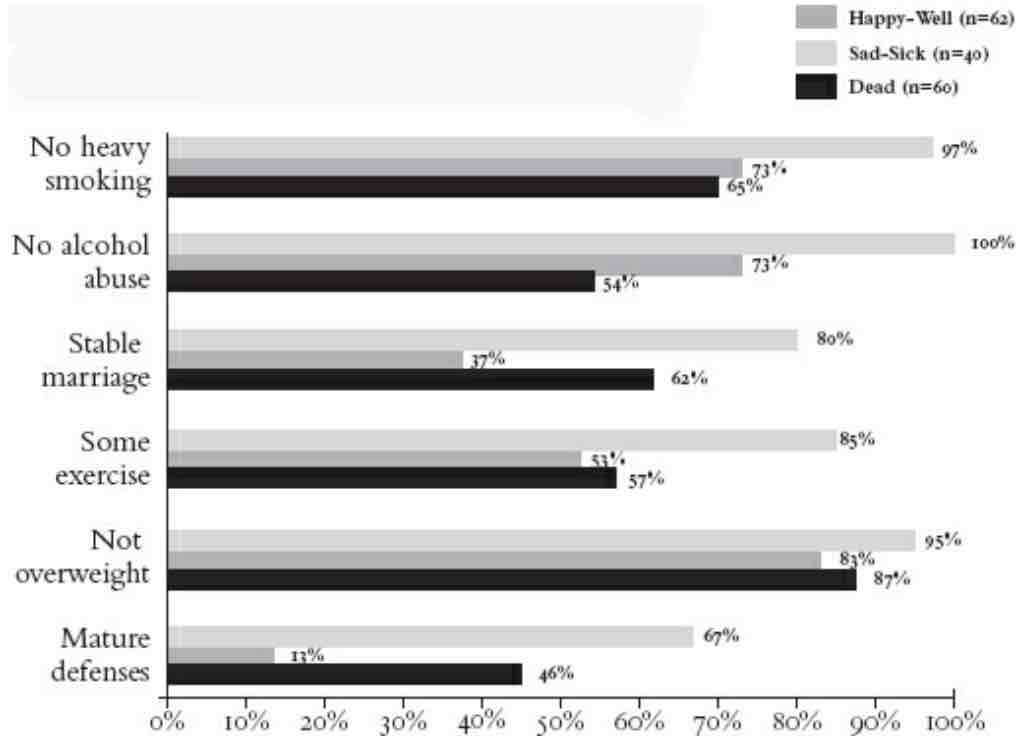 None of the above pieces of advice was “inherit a billion dollars” or “win the Olympic gold medal in ice dancing.” They’re things we all can do, even if that means forming new relationships or taking some college classes at night.
A good life is not outside your reach. It will take some effort — but you knew that, right? The important part is that it’s in your control. Frankly, George said it best:
“Whether we live to a vigorous old age lies not so much in our stars or our genes as in ourselves.”
Join over 320,000 readers. Get a free weekly update via email here.
Related posts:
Subscribe to:
Posts (Atom)